Blog

Law Librarians Learn About and Support Local Innovation

By the LLNE Service Committee

photo

On November 12, 2015, law librarians Nicole Dyszlewski and Raquel Ortiz stopped by the Rochambeau Library’s Girls Who Code club to deliver 10 Raspberry Pi computers that members of the Law Librarians of New England donated to the club. The club is currently made up of six girls ranging in age from twelve to fifteen who have an interest in computer science and coding.

Girls Who Code is a nationwide organization that is working to close the gender gap in technology careers and education. The national organization supports local clubs to help inspire girls to pursue computer science careers by exposing them to instruction in computer programming, web development, web design, and robotics. The one public chapter of the Girls Who Code Club in Rhode Island is held at the Rochambeau Library in Providence. Kendra Saunders from Johnson and Wales University serves as the club’s volunteer instructor.

“Prior to the donation the girls were using Dell desktop computers that were running on Windows XP, which is quite out of date” wrote Rashaa Schoolcraft, the organizer of the Rochambeau Library’s chapter. “We were looking to get a few Raspberry Pi computers but were unsure of how we would purchase them.” So when Law Librarians of New England approached Schoolcraft to ask how they could be of service, the timing could not have been better. Raspberry Pi computers are approximately the size of a credit card, plug into a computer monitor, and use a standard keyboard and mouse. The units donated by LLNE cost about $70 each and are capable of running a variety of operating systems, giving users the ability to experiment with coding and creating their own programs.

Law Librarians of New England (LLNE) is a non-profit organization for professional law librarians throughout New England. Twice a year, LLNE hosts educational meetings for its members on different topics. This year’s fall meeting, titled Successfully Supporting & Igniting Innovation, was hosted by the library at Roger Williams University School of Law and featured local innovators and businesses from Rhode Island on the panels. In conjunction with the event, the LLNE Service Committee sought to support local innovative projects and ultimately chose to raise funds for the local public Girls Who Code club.

Archives Committee update

By Ron Oppenheim

Greetings, LLNEers!  This abbreviated post is focused on you, the member/user/history-seeker.  We’ve got some ideas bubbling about content we’d like to show you that we are still tinkering with a bit and, in the interim, we wanted to reach out to find out what you want to see.

Let us know if there’s anything in particular you’re interested in, whether it’s a topic, time period, or event; we’ve got some cool stuff in our archives, i.e., photos of dated hairstyles (we kid, we kid…).

Speaking of photos, if you have any from past LLNE events that you’d like to share or donate to our archives, please reach out to us (you can email Ron here).  If you have any other materials that you think might want to make the archives their home, please contact him as well for more details.

Hope everyone has a happy and safe holiday season!

Job Posting: Law Librarian I-Connecticut Judicial Branch

Posted on behalf of Jeff Dowd, Supervising Law Librarian, Law Library Services Connecticut Judicial Branch.  Please contact him directly with any questions: Jeffrey.Dowd@jud.ct.gov

Law Librarian I – Connecticut Judicial Branch

Primary work location is Middletown, CT, but may be required to work in other locations two days a week.

The Connecticut Judicial Branch is seeking a qualified individual to perform professional to advanced library duties which include providing legal reference and research guidance, instruction in database searching, and catalog and collection maintenance. In-state travel is required.

Minimum Qualifications: A Master’s degree in Library Science or Information Science from a graduate school accredited by the American Library Association. Information about the position is posted on the Connecticut Judicial Branch web site.

Applications must be received by December 21, 2015. Applications should be submitted through the on-line application site at: https://www.jud.ct.gov/hronline/. Paper applications will not be accepted.

Please reference posting ID #15-1000-038 AA/EOE

Legal Tech: Trello

By Carli Spina

Whether you are working on managing a solo project or coordinating the work of an entire team, organization is a key part of project management. But, it can be tough when you have your activities spread across multiple platforms and email accounts. Trello is designed to streamline and simplify this process.

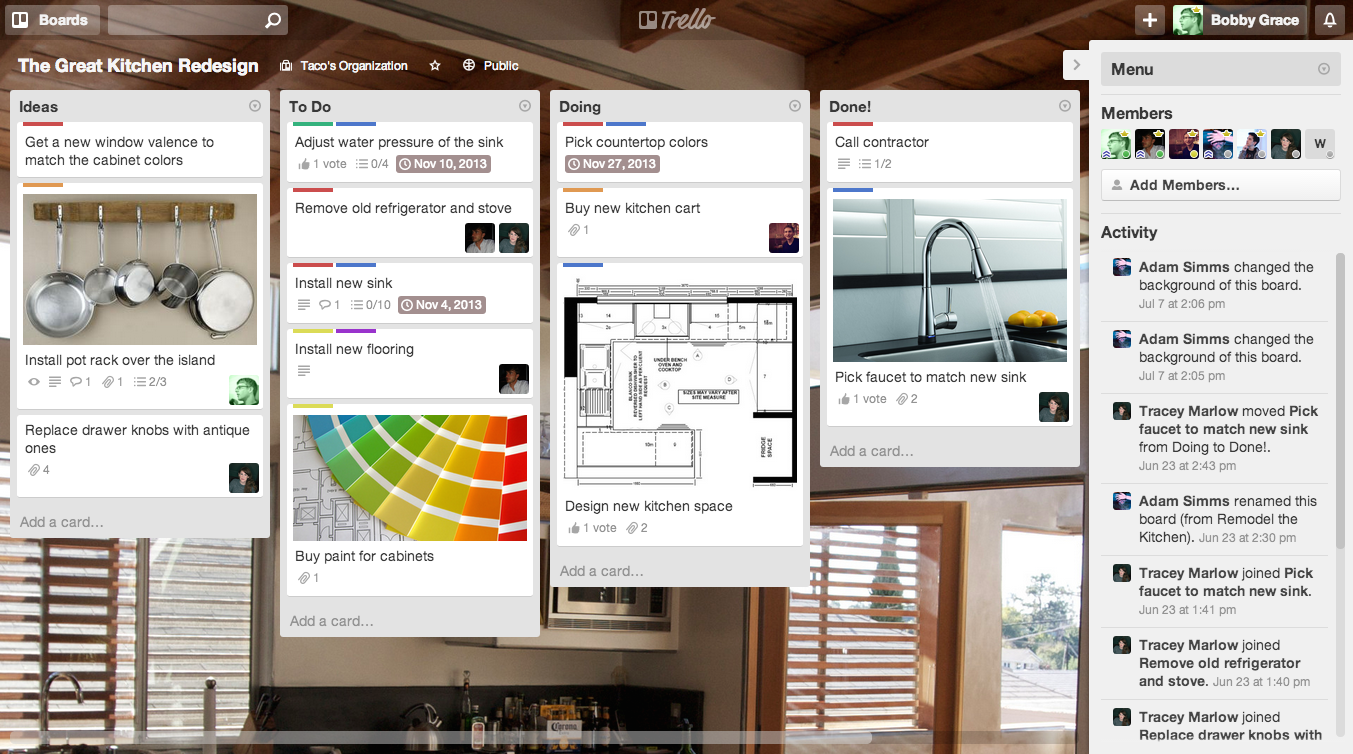
Trello is designed to allow you to split your projects onto separate boards. You can then add “lists” to each board to represent the various stages of the project from planning to completion and put individual tasks on their own “cards.” Though the terminology of this system might seem foreign at first, this structure makes it easy to move tasks from start to finish by simply dragging the corresponding card to the proper list as each stage of the task is completed. Cards themselves can include a wealth of information, from tags to checklists to deadlines. If you have documents from outside Trello that are relevant to the task, you can even attach them to the card.

Web page screen shot
Trello

While this can be a useful tool for keeping a solo project organized, it becomes even more useful when you are working with a team. Each level of Trello’s organization from board to card can be shared with collaborators. Each individual can set their own preferences for how they will get updates on the status of the project, including the option to receive regular emails. Trello even supports @-mentions, so you can have targeted conversations with individuals within the platform if that fits your workflow. And, since each board can be private, public, or team viewable, you have significant control over who will have access to each of your projects. To keep your project under control while you are on the go, Trello also has apps for Kindle Fire, iOS, and Android devices.

Another one of Trello’s strong suits is its documentation. It has a detailed guide to help you get started, which includes videos and example boards, a blog with additional tips, and an Inspiration space. Trello is a strong tool for a wide range of types of projects, but if you want library-specific inspiration, Aaron Tay recently wrote a blog post about how Trello is being used in libraries, which highlights great examples of how libraries are using Trello for all sorts of work from website redesigns to vendor negotiations. I highly recommend checking out Aaron’s post for some ideas about how your library might use Trello to manage projects and streamline team collaboration.

Happy Thanksgiving from LLNE!

Happy Thanksgiving

Image by John Morgan. Shared under a Creative Commons Attribution license.


It took several iterations of Thanksgiving before it became an annual federal holiday by act of Congress.  First, President Washington issued two proclamations for a day of thanksgiving (although they were six years apart).  Then, President Lincoln issued his own proclamation creating a day of thanksgiving during the Civil War.  Each year after that, the sitting president issued a proclamation naming a Thursday in November a national day of thanksgiving.  Finally, Congress officially made the fourth Thursday in November Thanksgiving beginning in 1941.  You can read more about federal holidays and how they were created in the CRS Report for Congress Federal Holidays: Evolution and Application.

Have a fun, relaxing, and happy Thanksgiving!

Education Committee Update

By Ellen Frentzen & Elliot Hibbler

As we’re writing this, Elliott has finished up a proposal  for an AALL/Bloomberg BNA Continuing Education Grant to fund an exciting new continuing education series from LLNE. More details coming soon!

Planning for the Spring Meeting, which will be held April 8 at Northeastern University, is also well under way. It will be a joint meeting with ABLL, and the theme is Access to Government information. Be sure to save the date for this one!

Elliott is also co-teaching the legal information sources class offered to MLS students at Simmons with fellow LLNE member Scott Akehurst-Moore. If you have the opportunity, please recommend the course to your Simmons friends (and of course, suggest they join LLNE—it’s only $5 for a student membership, and there are lots of great benefits).

We’d like to hear from you!

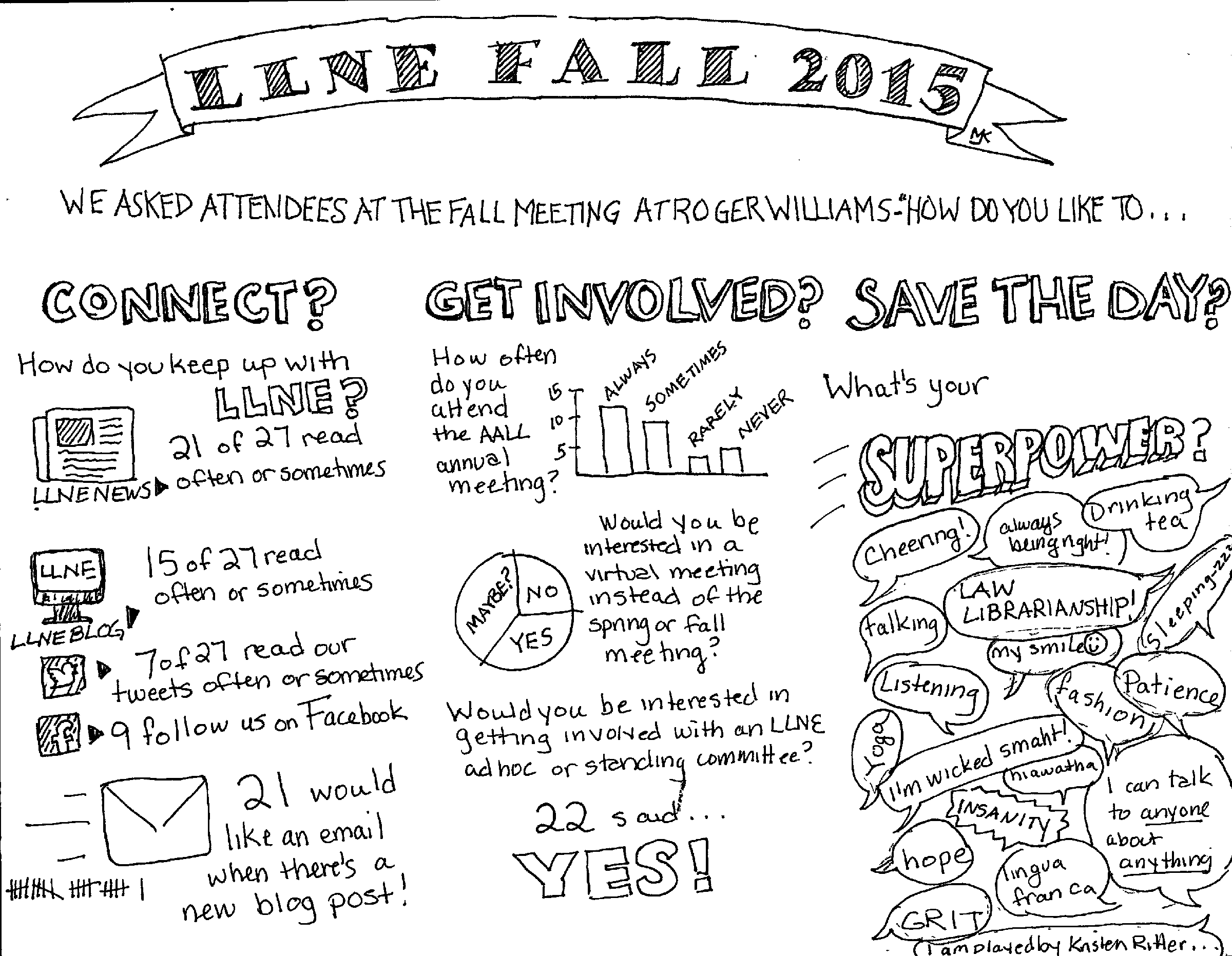
At the Fall Meeting at Roger Williams on October 2, current LLNE prez Diane D’Angelo conducted a quick poll of the attendees. Inspired by our keynote speaker Margaret Hagan of Stanford, and her fascinating presentation on how to use design to make information more engaging for users, I’ve sketched our (very unscientific) results here:

Fall meeting quick poll results. Details in the later linked document

Poll questions and results.

Bonus question: What year LLNE was founded?

We’d love to hear what you think too-please leave your ideas and answers in the comment section!

Massachusetts UELMA Update

By Emilie Benoit and Anne McDonald, Co-Chairs, LLNE Government Relations Committee

As noted in our July, 2015 blog, the Massachusetts UELMA bill  H. 43 was reported favorably out of the House Judiciary Committee following its May 27th hearing, and is now in the House Ways and Means Committee.

Michelle Pearse addressed members in attendance at LLNE Fall meeting at Roger Williams University School of Law, on the behalf of subcommittee Chair Barbara Morgan, about the UELMA in MA Subcommittee’s recent activities. She asked those LLNE members who are Massachusetts residents to contact their representatives, especially those who sit on the House Ways and Means committee.

LLNE President Diane D’Angelo sent a letter dated September 30, 2015 to Representative Brian Dempsey, Chair of the House Ways and Means Committee, urging him to favorably report the bill out of his committee.  The letter stresses the importance of adopting UELMA.  The full text of the letter, as well as the UELMA in Massachusetts information webpage, can be found here.

Most other New England state legislatures have adjourned for the year and will reconvene in January 2016.

The LLNE Government Relations Committee is providing this information to further its committee charge to keep you apprised of developments which may be of interest to you as an informed law librarian.

Archives committee updates

With summer officially behind us, the Archives & History Committee is ready to get started on its agenda for the year.  We’ve got a number of things planned, many of which would benefit from member input!

First and foremost, we’ll be conducting an inventory of our holdings.  There are three main reasons for this: 1.) it allows us to spot any acquisition priorities, gaps in our holdings, etc., 2.) it gives us a chance to revisit the processes we have in place and see if any need updating, and 3.) it lets us know what cool stuff we have and how best to showcase it!

One of the best ways to highlight our material is through this site, llne.org.  So another key goal we have is to increase the activity on the Archives & History portion of the site.  And this is where the member input part comes in.  Let us know what you’d like to see on the site.  Thoughts, ideas, or questions—however general or specific—are welcome, encouraged, and appreciated.

Lastly, we’ll also be starting to think about how we store our born-digital materials (i.e., those things that do not have a physical format).  Getting a solid digital preservation policy is key, as we are all aware of the growing number of things that only exist as ones and zeroes.  We’ve got a full plate for this year, but like I said in the previous post, I’m really excited about getting started.

Theory into Practice: Coverage vs. Comprehension

It’s been quite some time since I believed that Lecturing was the best way to teach legal research.  But I still find myself having the same dialogue, internal and external, that led me to believe that it is better to sacrifice comprehensive coverage for the sake of better retention:  do I assemble everything I know about research into a carefully crafted lecture where everything fits together perfectly (what I’ve come to call the “tetris lecture”)?  Or do I sacrifice the time it would take to explain,  for example, what the appellate division of the trial court is, where its decisions are found and what authority it wields, in the name of giving students practice doing hands-on research, analyzing fact patterns and discovering effective research strategies?  The answer seems clear:  I think it’s far more important to give students practice working through complex research problems than it is to devote the time to teach them how to navigate, say, the Descriptive Word Index, when the likelihood is they’ll never use one outside of law school (if even there!).

The answer seems clear.  But the problem is, every year, it seems like there is more to cover.  Every year we want to devote more time to practical work to make sure students “get it.” And so every year it seems that there is more to sacrifice.  For example, this year we want to devote more time to having students work through transactional research problems – which is a type of practice many of our graduates wind up in.  And so this year, we are seriously considering eliminating any time devoted to public international law, because the reality is, few if any of our current class are going to end up working in international human rights, with the United Nations, or for anyone else “doing” public international law (NB: at this point we do still cover private international law research, because our graduates are much more likely to encounter issues between private parties in separate nations, than they are to encounter issues between nations themselves).   But it pains me to do this, because I know this stuff; I love this stuff.  It seems like the right thing to do, especially given all of the hub bub about “practice ready” graduates.  But the warehouse of knowledge I will likely never share – how to deftly assemble all of the necessary Shepard’s volumes and supplements for an accurate analysis, or how to link up the dates of the various lists of sections affected so as to not miss a single federal register – is growing.

Does this story seem familiar?  Are you having to sacrifice things you know and love to teach, in the name of making sure students walk away more competent and confident?  If so, what have you dropped?