AALL is now accepting nominations for the Emerging Leader Award. This award recognizes newer members who have made significant contributions to the profession and have demonstrated the potential for leadership and continuing excellence. Self-nominations are accepted and encouraged.
Selection criteria
The nominee must:
· be a member in good standing of AALL
· have 10 or fewer years of law library experience
· have made a significant contributions to the Association and/or the profession
· have shown outstanding promise for continuing service and leadership (please provide specific examples of his/her continuing activities)
· not have previously received an Emerging Leader Award
The nomination deadline is January 31st. Letters of recommendation can take some time to gather and holidays are approaching, so we encourage you to begin the process as soon as possible in order to meet the deadline.
The U.S. Courts Library for the Second Circuit has an opening for a branch librarian in New Haven, Connecticut. This is an exciting position with the opportunity to work closely with our federal appellate, district, and bankruptcy judges, law clerks, and court staff.
The New Haven Library is located on the Green in the historic Richard C. Lee U. S. Courthouse. Between our Manhattan headquarters library and six branch libraries, we currently have a staff of twenty-four.
Some of our members have been hard at work publishing articles in AALL Spectrum. Below are two articles that have recently been published in the September/October edition. Please give them a read and join us in congratulating the authors!
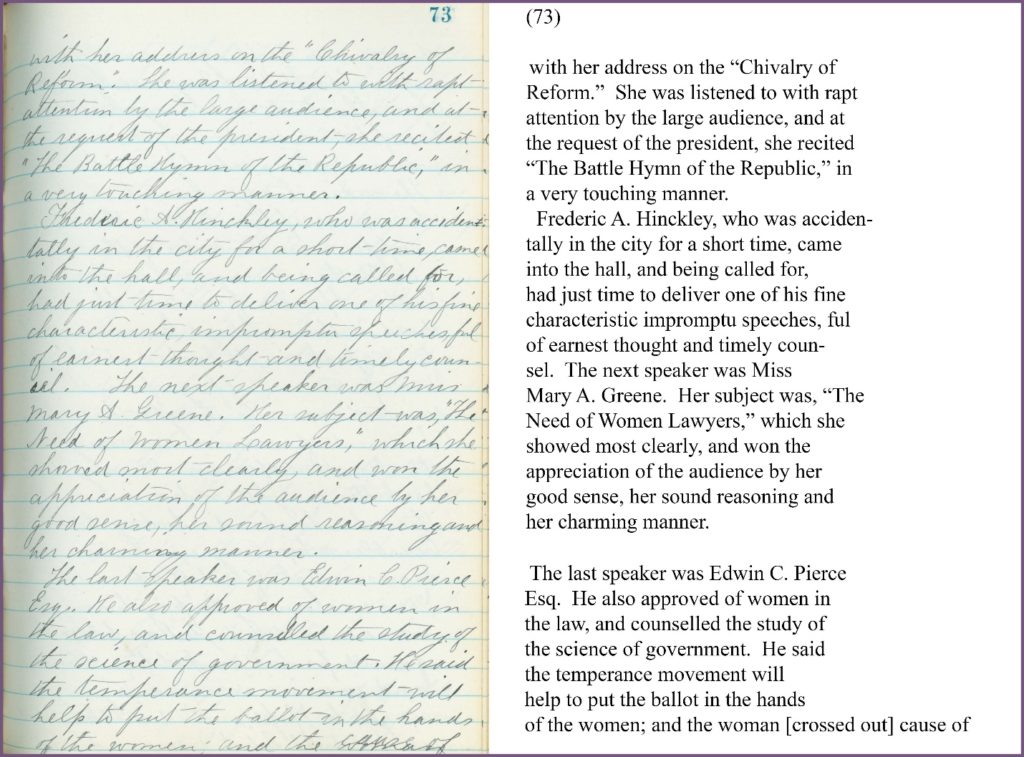
This year the LLNE Service Committee continued to work closely with the Rhode Island State Archives for its 2019 spring project. Participants transcribed handwritten document pages virtually, from the comfort of their own homes or offices, which was a different approach to the transcription party that was held on Roger Williams University’s Providence Campus in November of last year. Participants received 5 pages (with the ability to request less or more to work on) from the Rhode Island Equal Suffrage Association (RIESA) journal, which is comprised of minutes, written in late 19th century cursive, of the meetings held between 1888 and 1892. Also included for participants were transcription tips and helpful resources on how to read historical handwriting.
I was unable to attend the transcription party in November, so Iwas excited to be given an opportunity to transcribe pages virtually. I’ve worked on transcription projects in the past for my place of employment and as a volunteer for the genealogical research site FamilySearch, and over time I’ve found that I actually really enjoy it. Older handwriting can be incredibly frustrating to read, and it often requires a bit of detective work; getting a sense of the way the author stylized certain letters and words and figuring out the context of the document, if it’s not immediately apparent, can often provide important pieces to the puzzle. And what librarian doesn’t like a little bit of a research-related challenge?
I was assigned five pages in the RIESA journal that were a summary of a meeting held in 1891, and the main topics that were discussed included the need for women in law and government, the enfranchisement of women, and the protection of children factory workers. It was incredibly easy to view the document online (no downloading was necessary) and write my transcription in Word. I was fortunate that the secretary who took the notes for this particular meeting wrote relatively clearly, and it may have taken me no more than an hour of my time altogether to transcribe the pages. There were a couple words I scratched my head over (like “grogshop”???), but by the end I was confident that I had everything transcribed correctly—spelling and grammatical mistakes included, even though it’s sotempting to make corrections! It was also neat to read first-handabout the different speeches given during this spirited meeting by well-known names such as Mary Ann Greene and William Lloyd Garrison, with Anna Garlin Spencer presiding over the meeting.
Once the transcription was complete, I emailed the file to the Rhode Island State Archives. While certain types of documents can be fed through optical character recognition (OCR), transcribing handwriting requires manual effort and time; it felt good to be able to help provide greater access to this important association’s records for researchers and the general public.
The election results are in. 102 members took the time to vote – that’s a solid showing of around half of our membership.
Congratulations to our newly elected 2019-2020 officers!
VP/President Elect: Nicole Dyszlewski
Treasurer (2 year term): Rachel Weiss
Secretary (1 year term): Christie Schauder
Education Director (2 year term): Maureen Quinlan
This new slate – alongside our current VP/President Elect, Bob DeFabrizio – will officially begin their terms on July 1, 2019. We will also have a transition ceremony at our Fall Meeting later this year.
Many thanks to our new officers for their willingness to serve, and to our outgoing Treasurer, Rick Buckingham; Education Director, Danitta Wong; and Secretary, Nicole Dyszlewski, for their excellent contributions and dedication to LLNE.