ANHLL Invites LLNE Members: Monday, October 16th in NH

Interested in hearing from the people behind the editorial enhancements in Westlaw?  The Association of New Hampshire Law Librarians is having a meeting on Monday, October 16th at 2:00pm at McLane Middleton in Manchester and invites LLNE members to join them. Their speakers (via videoconference) are from Westlaw: Bob Smits for KeyCite questions, plus someone from the headnote writing group and the classification group.

If you are an LLNE member interested in attending, please contact Mary Searles at msearles@courts.state.nh.us .

From LLNE Scholarship Winner, Jessica Almeida

My AALL Conference Journey

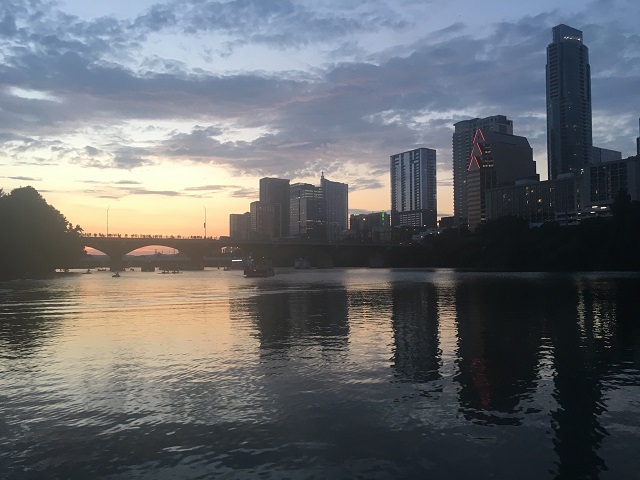
I had the great fortune of receiving a scholarship through LLNE to attend the AALL conference in Austin.  As I write this, I am flying home from Austin filled with new ideas and new opportunities for further collaboration.  As a first-time attendee, I had no idea what to expect.  So, I asked every law librarian I knew for advice.  I joined the AALL Host Program, so I could ask the librarian I was paired with for advice.  I scoured over the schedule and planned my time down to the minute.  I got new business cards and packed comfortable shoes.  After four amazing and exhausting days in Austin, I know that these takeaways will contribute to my development as a professional.

At every program I attended, I took away something meaningful.  Working in public services, I gravitated toward programs where I learned how to put together successful DYI marketing materials and curate interesting social media content.  I also learned about how to better serve our transgender patrons and how to make the library more accessible after hours.  Throughout the conference, I tried to fully participate, whether through discussion, tweeting during presentations and events, or engaging passerbys during poster sessions.

I found attending the roundtables gave me a greater perspective on how our little library stacks up in the larger world of law libraries.  I was also able to gain insight into innovative programs that other libraries are adopting as well as shared my own experiences.

One of my unexpected favorite sessions of the conference was a discussion den where a small group of women discussed raising families, working full time, and making time for professional development.  Being six months pregnant with my second child, this discussion really resonated with me.

For me, the greatest part of the conference was all the wonderful law librarians I met and spoke to.  In all honesty, I am a bit shy.  Four days of attempting to initiate conversations can be a little overwhelming.  But I want to thank all the wonderful librarians who took the time to speak with me.  From the law librarians on the plane and the shuttle bus to all the RIPS and LISP members who I only knew through email as well as all the LLNE members who introduced themselves or remembered me from previous meetings.  Thank you.  Your kindness and generosity helped make my first AALL conference a success.


Updated: Fall 2016 Meeting

The LLNE Fall Meeting will be held in Portland Maine, at the Westin Harborview Hotel on Friday October 28, 2016.  For links to the conference and hotel reservations see: http://lawguides.mainelaw.maine.edu/c.php?g=562485

The program, entitled By The Numbers: Law Library Assessment, will focus on the tools used for data collection in law libraries and assessment of all segments of law librarianship.  Teresa Migel-Sterns, Director of the Yale Law Library will talk about ALLStAR Benchmarking, a tool to be used in academic law libraries for data collection and analysis.

Scott Bailey, Director of Research Services at Squire Sanders in D.C., will be discussing a project he and the Private Law Librarians & Information Professionals SIS of AALL has developed for assessing the work of private law libraries.

A third session will be an UN-Conference focusing on the new ABA Standards for Outcome Assessments and what academic law librarians are doing to comply with these standards in their legal research instruction.  This will be led by Stephanie Weigmann, Associate Director for Research, Faculty Services and Educational Technology at Boston University School of Law.

Last, but certainly not least, the afternoon will be capped off with a celebration of LLNE’s 70th Anniversary.  There will be cake and champagne and displays filled with LLNE memories!  So reach out to the retired members you still keep in touch with and invite them to join us in our celebration!

Registration for the meeting will be 40.00 per person, with a reduced rate for retired LLNE members and students (20.00).  There is a block of rooms set aside for this meeting at the Westin Harborview Hotel to be reserved at a reduced rate.

A Deep Dive into Big Data

A Deep Dive into Big Data

Brian Flaherty

I have a colleague who now and again laughs about the time “when we were wizards.”  When we reference librarians would wave our wands (or eyes) over digests or (worse yet) shepards – gibberish to mere muggles – and come up with citations to relevant legal authority crowned with the title “good law.”  He points out that we are no longer wizards – that with google scholar & well chosen search terms, people unfamiliar with the law are able to do adequate legal research (of course, I’m quick to point out that “adequate legal research” just doesn’t cut it these days).

I say this because just now, I think some librarians look at “big data” as mystical, and at the folks who can harvest and manipulate it as magicians.  But demystifying it is, I think, essential for a clear understanding of what’s behind it, how powerful it is, and how it can be used.  The “Deep dive” on big data went a long way towards doing this.  I am going to attempt a short summary, but what I write here will be inadequate.  I urge everyone to get the powerpoints and reading lists from the AALL site when they’re available, and become familiar with this.  The overused phrase fits here: it is the future of the law practice.

Briefly: Big Data are information sets that are too large or complex for traditional processing models.  For example: a data set including every federal case would be “Big data.”  Robert Kingan from Bloomberg Law began the program with a great definition of what constitutes big data, and a discussion of just how difficult it is to collect it in a form that is useful for any kind of analysis.  He said that some 80-90% of the work for any kind of a project is just collecting and cleaning the data, putting it into a format where it can be used.  Think, for example, of getting the aforementioned set of all federal cases into a spreadsheet, where one column was “Judges name” and you begin to get a feel for how huge an endeavor this is.  Daniel Lewis from Ravel talked a bit about how they go about manipulating the data once they’ve got it – with a short discussion of the uses of SQL and NoSQL (“Not Only SQL”) and the benefits of both.  Irina Matveeva from NexLP gave a short discussion of Language Processing – what would seem to be the next step of data analysis – where there are programs that can do document analysis, email forensics, and other linguistic manipulation extremely quickly.

Following this introduction, and a brief discussion of how BloomberLaw (Robert), Ravel (Daniel) and NextLP harness Big Data in the resources they provide, we were given the opportunity to explore what planning a “Big Data”project would be like.  Folks got into groups at tables and devised a possible project, a list of some of the resources they would need, and a list of some of the necessary players (e.g. librarians, programmers, 3rd party vendors).  Some of the ideas were fantastic: one table talked about creating a predictive tool that could be used to determine whether a law enforcement officer would be likely to be accused of a civil rights violation – and what kind of data sources would be necessary to create such a tool (personal history? Demographic information?).  At our table, one person was engaged in creating a resource that would predict the likelihood that a piece of legislation would pass – and so we talked about the data necessary to do that: the sponsor’s history, party affiliation, words in bill titles that have passed, public sentiment (retrieved from news sources & social media).

In all, Big Data is fascinating stuff – incredibly useful for its predictive value of everything from the outcome of a court case, to the passage of legislation.  Not only should we be paying attention, we should be “deep diving” into it, to understand what it can do for us and the legal community.

Dispatches from AALL: Chicago – On Gender

AALL Chicago: On gender

by Brian Flaherty

Welcome to Chicago & AALL – if only by remote. I want to include here a few dispatches from AALL, if only to be expanded on at home.
I wanted to start by commending the SR-SIS, and specifically the committee on Lesbian and Gay Issues, for offering “Pronoun choice” ribbons in the exhibit hall. These are the lime-green ribbons dangling from our nametags that read “My pronouns are” – and then different options: he/him, she/her, they/them, and an ribbon with a blank, with an available sharpie to write in the pronoun of your choice. Bravo.
A quick digression into why this is important, and why I think it’s important for cisgendered folks like me (cisgender: a person whose gender presentation and identity match their biological sex) to wear them. We live in a world that that tries to enforce gender norms – tries to assign us a gender – at every turn. From honorifics to pronouns, to the way we’re treated at the grocery store, to the way we’re greeted at a conference. For someone who doesn’t spend a lot of time thinking about gender, this “gendering” of the world blends into the quotidian – it’s just the way things are. But for folks who think about gender a lot, for example, folks whose gender presentation doesn’t correspond to their sex-assigned-at-birth, this constant mis-gendering is a relentless reinforcement of the idea that they don’t fit in.
Using someone’s chosen pronoun may seem like a small part of changing the world but there’s that maxim about the thousand mile journey beginning with the single step? There’s also something somewhere about the first step being the hardest but most important (if only I had a librarian nearby to help me look it up… oh, wait…). One day perhaps, the phrase “do you have a preferred pronoun?” will be as common as “what was your name again?” (a phrase increasingly common as I age). Until then, however, explicitly allowing people to claim a pronoun is a great stop.
My gender presentation matches my biological sex (I am cisgender), and the pronouns I use are he/his/him. Moreover, by my presentation in the world, I don’t anticipate being mis-gendered by pronoun or otherwise. Still, I wear this ribbon proudly (and to be very clear: I’m encouraging all of you to stroll on over to the SR-SIS folks and ask for a ribbon) to reinforce the notion that sex-assigned-at-birth and gender presentation don’t always match. And while we were all a bit young to have a say in how we were called that first day, we all should have a say in what we are called today.

Proposed Bylaw Changes

At the request of the LLNE President, an ad hoc committee was charged to look at possible changes to the LLNE bylaws with the intent of streamlining the election process.

The committee’s report with the proposed bylaw changes, is now available for review. The text has also been submitted for review to the AALL Bylaws committee.

We hope to vote on the proposed changes at the Spring Meeting.

Submitted by the Ad Hoc Bylaws Committee

Elaine Apostola, chair, Elliott Hibbler, Mindy Kent and Barbara Schneider