Dispatches from AALL: Chicago – On Gender

AALL Chicago: On gender

by Brian Flaherty

Welcome to Chicago & AALL – if only by remote. I want to include here a few dispatches from AALL, if only to be expanded on at home.
I wanted to start by commending the SR-SIS, and specifically the committee on Lesbian and Gay Issues, for offering “Pronoun choice” ribbons in the exhibit hall. These are the lime-green ribbons dangling from our nametags that read “My pronouns are” – and then different options: he/him, she/her, they/them, and an ribbon with a blank, with an available sharpie to write in the pronoun of your choice. Bravo.
A quick digression into why this is important, and why I think it’s important for cisgendered folks like me (cisgender: a person whose gender presentation and identity match their biological sex) to wear them. We live in a world that that tries to enforce gender norms – tries to assign us a gender – at every turn. From honorifics to pronouns, to the way we’re treated at the grocery store, to the way we’re greeted at a conference. For someone who doesn’t spend a lot of time thinking about gender, this “gendering” of the world blends into the quotidian – it’s just the way things are. But for folks who think about gender a lot, for example, folks whose gender presentation doesn’t correspond to their sex-assigned-at-birth, this constant mis-gendering is a relentless reinforcement of the idea that they don’t fit in.
Using someone’s chosen pronoun may seem like a small part of changing the world but there’s that maxim about the thousand mile journey beginning with the single step? There’s also something somewhere about the first step being the hardest but most important (if only I had a librarian nearby to help me look it up… oh, wait…). One day perhaps, the phrase “do you have a preferred pronoun?” will be as common as “what was your name again?” (a phrase increasingly common as I age). Until then, however, explicitly allowing people to claim a pronoun is a great stop.
My gender presentation matches my biological sex (I am cisgender), and the pronouns I use are he/his/him. Moreover, by my presentation in the world, I don’t anticipate being mis-gendered by pronoun or otherwise. Still, I wear this ribbon proudly (and to be very clear: I’m encouraging all of you to stroll on over to the SR-SIS folks and ask for a ribbon) to reinforce the notion that sex-assigned-at-birth and gender presentation don’t always match. And while we were all a bit young to have a say in how we were called that first day, we all should have a say in what we are called today.

Proposed Bylaw Changes

At the request of the LLNE President, an ad hoc committee was charged to look at possible changes to the LLNE bylaws with the intent of streamlining the election process.

The committee’s report with the proposed bylaw changes, is now available for review. The text has also been submitted for review to the AALL Bylaws committee.

We hope to vote on the proposed changes at the Spring Meeting.

Submitted by the Ad Hoc Bylaws Committee

Elaine Apostola, chair, Elliott Hibbler, Mindy Kent and Barbara Schneider

Job Posting: Law Librarian I-Connecticut Judicial Branch

Posted on behalf of Jeff Dowd, Supervising Law Librarian, Law Library Services Connecticut Judicial Branch.  Please contact him directly with any questions: Jeffrey.Dowd@jud.ct.gov

Law Librarian I – Connecticut Judicial Branch

Primary work location is Middletown, CT, but may be required to work in other locations two days a week.

The Connecticut Judicial Branch is seeking a qualified individual to perform professional to advanced library duties which include providing legal reference and research guidance, instruction in database searching, and catalog and collection maintenance. In-state travel is required.

Minimum Qualifications: A Master’s degree in Library Science or Information Science from a graduate school accredited by the American Library Association. Information about the position is posted on the Connecticut Judicial Branch web site.

Applications must be received by December 21, 2015. Applications should be submitted through the on-line application site at: https://www.jud.ct.gov/hronline/. Paper applications will not be accepted.

Please reference posting ID #15-1000-038 AA/EOE

Happy Thanksgiving from LLNE!

Happy Thanksgiving

Image by John Morgan. Shared under a Creative Commons Attribution license.


It took several iterations of Thanksgiving before it became an annual federal holiday by act of Congress.  First, President Washington issued two proclamations for a day of thanksgiving (although they were six years apart).  Then, President Lincoln issued his own proclamation creating a day of thanksgiving during the Civil War.  Each year after that, the sitting president issued a proclamation naming a Thursday in November a national day of thanksgiving.  Finally, Congress officially made the fourth Thursday in November Thanksgiving beginning in 1941.  You can read more about federal holidays and how they were created in the CRS Report for Congress Federal Holidays: Evolution and Application.

Have a fun, relaxing, and happy Thanksgiving!

We’d like to hear from you!

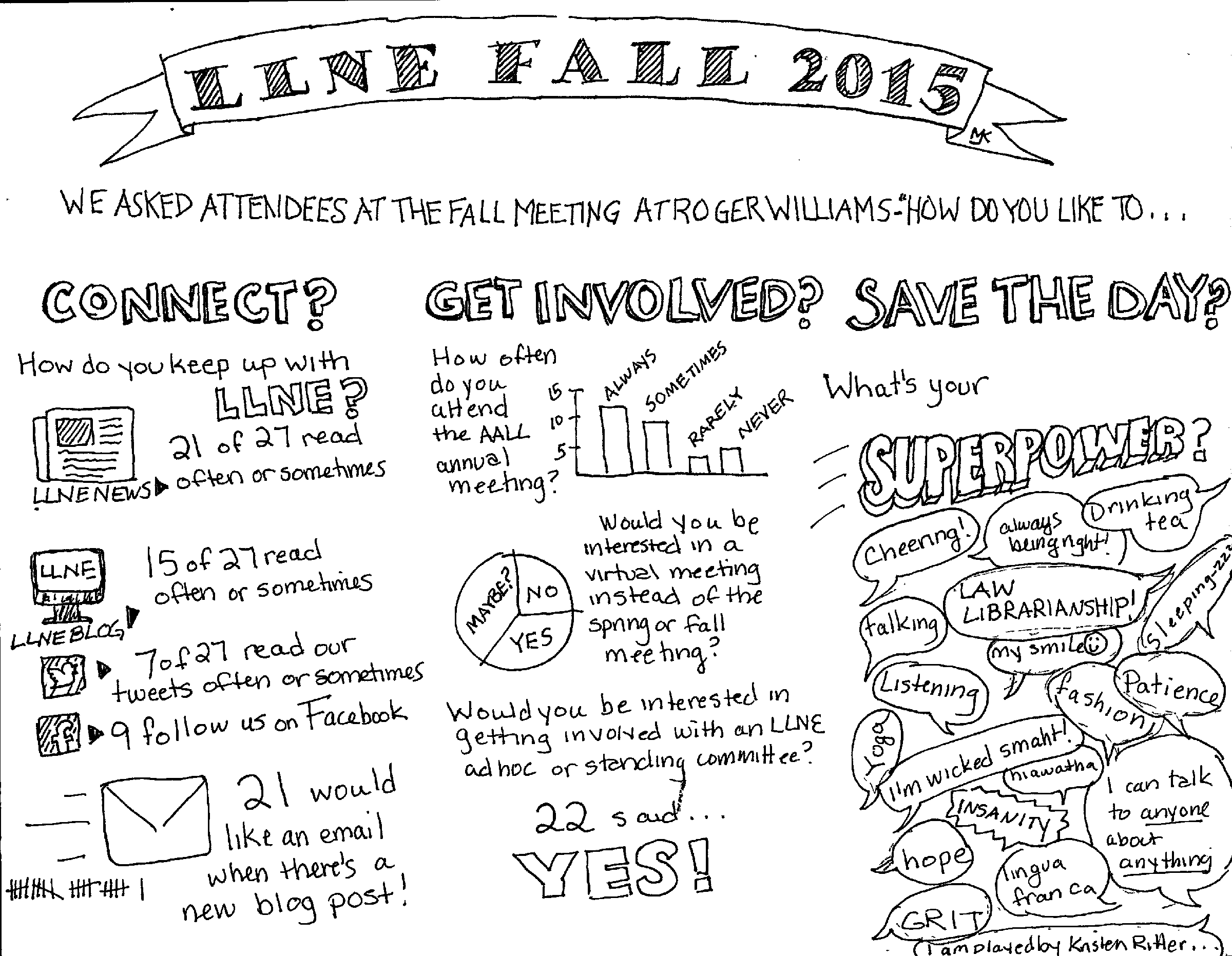
At the Fall Meeting at Roger Williams on October 2, current LLNE prez Diane D’Angelo conducted a quick poll of the attendees. Inspired by our keynote speaker Margaret Hagan of Stanford, and her fascinating presentation on how to use design to make information more engaging for users, I’ve sketched our (very unscientific) results here:

Fall meeting quick poll results. Details in the later linked document

Poll questions and results.

Bonus question: What year LLNE was founded?

We’d love to hear what you think too-please leave your ideas and answers in the comment section!

Vermont Law School Library Opens to Public

Please find the press release below announcing the start of the Vermont Law School’s new legal information services to the public.

SOUTH ROYALTON, Vt., July 21, 2015––The Julien and Virginia Cornell Library at Vermont Law School will provide legal reference services to the public beginning this week, Vermont Law School President and Dean Marc Mihaly announced today. The law school seeks to fill the gap in services created with the closure of the Vermont State Library’s law library program in Montpelier.

“We are pleased to share our extensive legal resources with our Vermont neighbors,” Mihaly said. “Cornell Library serves as the intellectual foundation for legal education and scholarship at Vermont Law School, and our librarians are among the best in their field. I applaud our library staff for stepping up to provide this important service to the community.”

Included among the services available to the public are a new VLS “Ask a Law Librarian Line” at 802-831-1313, for reference requests by phone, and a new Community Legal Information Corner (CLIC) equipped with two public-access computers with Westlaw, an online legal research service, and a legal self-help collection. The CLIC is located on the first floor of Cornell Library adjacent to the main computer lab.

“Libraries play an important role in providing access to justice,” said Professor Cynthia Lewis, director of the Cornell Library at VLS. “The closure of the state law library program will have an impact on attorneys, alumni and, most importantly, self-represented litigants in Vermont. Our plans include serving as an information resource not only for self-represented litigants, attorneys and alumni, but also for public librarians who assist Vermonters with reference questions about legal issues.”

Cornell Library submitted a proposal to the state last spring, and the legislature subsequently approved a $67,000 grant to offset the costs associated with VLS opening its library doors to the public.

The 35,000-square-foot Julien and Virginia Cornell Library at Vermont Law School overlooks the White River in South Royalton and houses the school’s extensive collections, including a nationally recognized environmental law collection. For more information about the library, visit vermontlaw.edu/academics/library, email clewis@vermontlaw.edu or call 802-831-1313.

Dispatches from AALL Philadelphia – Something I learned: Electronic routing and current awareness

From Jessica Panella: Sometimes small snips of ideas can be very powerful and helpful. From LLNE’s own Boston University School of Law Fineman and Pappas Law Libraries was a poster on expanding a library’s current awareness lineup.  Jennifer Robble, Corinne Griffiths  and Rebecca Y Martin reviewed an interdepartmental task force which implemented an electronic routing system for faculty routing. The library is still providing electronic routing services for roughly 175 unique titles using JournalTOCs, MyHein Title Alerts and publisher specific resources. I am totally taking this back to UConn School of Law.

Happy 4th of July!

Happy Fourth of July from the Law Librarians of New England!  Here are some fireworks safety tips and legal reminders from mass.gov.  There are similar useful pages for  VermontConnecticut, New HampshireRhode Island, and Maine.  Each state approaches fireworks slightly differently; some allow nothing, some allow sparklers, some allow non-aerial fireworks with permits, and some don’t allow any non-licensed fireworks displays at all.

Stay safe and enjoy the holiday!

LLNE Legal Research Instruction Program

Every year LLNE runs the Legal Research Instruction Program, offering legal research training to folks in the community, from technical services librarians to library students, for the amazingly low price of $150.00. This was my first year administering the program, and it made me realize how much it depends on the incredible support of LLNE members. So I want to take a moment to thank those who made this awesome program happen:

  • Claire DeMarco from Harvard, for giving everyone a great overview of the legal system.
  • Rick Buckingham from Suffolk, for teaching the ins-and-outs of caselaw research
  • Kristin McCarthy from New England Law, for a nifty overview of statutes
  • Steven Alexandre de Costa from Boston University, for a dive into administrative law (and additionally, for inspiring at least one of our attendees to comment on proposed administrative law through regulations.gov)

And last, but certainly not least, a huge thank you to Ron Wheeler and Suffolk University Law Library for hosting the Legal Research Instruction Program. In all, we had 9 students, gave out 2 scholarships, and ran 6 individual sessions. Thank You!