Blog

Vermont Law School Library Opens to Public

Please find the press release below announcing the start of the Vermont Law School’s new legal information services to the public.

SOUTH ROYALTON, Vt., July 21, 2015––The Julien and Virginia Cornell Library at Vermont Law School will provide legal reference services to the public beginning this week, Vermont Law School President and Dean Marc Mihaly announced today. The law school seeks to fill the gap in services created with the closure of the Vermont State Library’s law library program in Montpelier.

“We are pleased to share our extensive legal resources with our Vermont neighbors,” Mihaly said. “Cornell Library serves as the intellectual foundation for legal education and scholarship at Vermont Law School, and our librarians are among the best in their field. I applaud our library staff for stepping up to provide this important service to the community.”

Included among the services available to the public are a new VLS “Ask a Law Librarian Line” at 802-831-1313, for reference requests by phone, and a new Community Legal Information Corner (CLIC) equipped with two public-access computers with Westlaw, an online legal research service, and a legal self-help collection. The CLIC is located on the first floor of Cornell Library adjacent to the main computer lab.

“Libraries play an important role in providing access to justice,” said Professor Cynthia Lewis, director of the Cornell Library at VLS. “The closure of the state law library program will have an impact on attorneys, alumni and, most importantly, self-represented litigants in Vermont. Our plans include serving as an information resource not only for self-represented litigants, attorneys and alumni, but also for public librarians who assist Vermonters with reference questions about legal issues.”

Cornell Library submitted a proposal to the state last spring, and the legislature subsequently approved a $67,000 grant to offset the costs associated with VLS opening its library doors to the public.

The 35,000-square-foot Julien and Virginia Cornell Library at Vermont Law School overlooks the White River in South Royalton and houses the school’s extensive collections, including a nationally recognized environmental law collection. For more information about the library, visit vermontlaw.edu/academics/library, email clewis@vermontlaw.edu or call 802-831-1313.

Legal Tech: Firefox Hello

By Carli Spina

These days, our patrons are always on the move. Whether this means a lawyer who is traveling for a client or a law student who is studying abroad, law librarians increasingly are faced with providing high quality reference service over long distances. While this frequently means lots of emails, this isn’t always the best way to answer questions or demonstrate techniques. Moreover, email can’t reproduce the personal interaction of a face-to-face meeting. Many libraries have experimented with using video chat to improve these long distance interactions, but often these tools have required that both the librarian and the patron have software pre-installed on their computer, which can be difficult depending on the technological skills possessed by the patron among other variables. Firefox Hello, a new chat tool from Firefox addresses many of these issues and offers a nice way to connect more personally with patrons no matter where they may be.

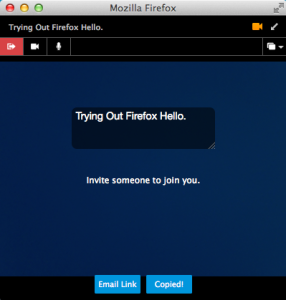
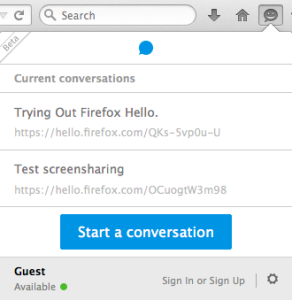
One of the greatest advantages of Hello is that it requires no login or account. Anyone with the latest version of Firefox installed on their computer may start a Hello session by clicking on a chat bubble icon at the top of the browser window as seen below without having to create an account or install a separate application.

Screen Shot 2015-07-17 at 10.12.24 PM

Clicking on the chat bubble reveals a dropdown menu as seen below. The menu includes your Hello history and the option to launch a new conversation. Each new conversation can be named and then you can email or copy the URL to share with anyone. To join the conversation, the recipient of the link need only be using a WebRTC-supported browser. This means anyone who has access to Firefox, Chrome, or Opera will be able to accept your conversation invitation simply by clicking on the link and then clicking on the join the conversation button in the resulting window.

Screen Shot 2015-07-17 at 10.18.56 PM

Screen Shot 2015-07-17 at 8.12.17 AM

Once a chat has been initiated, participants will enter into a video chat window if they have a web camera enabled on their computer. However, at any point, a participant may choose to mute either the audio or the video on their side of the conversation.

While all of these features make Hello very useful and usable, what really sets it apart is the screensharing options that are integrated into this tool. Using this feature, either party can share either the tabs in their browser or any other window they have open on their computer. This makes Hello an invaluable tool for collaborating on projects, troubleshooting technical difficulties that patrons may encounter, or demonstrating tricky navigation or search techniques in databases.

Whether the patron is in another building on campus or in another country, Hello’s features can make online reference interactions more personal and effective. If this sounds like a tool that would be useful to your patrons, you can learn more about the Terms of Service and Privacy Policy or take a tour.

LLNE Legal Link Launches!

By the LLNE Service Committee

The Service Committee is proud to announce that LLNE Legal Link, our legal research web portal, is now live and you can access it here and from the LLNE homepage. We will be debuting the website at AALL this week in Philadelphia, passing out postcards at the LLNE booth, so be sure to help spread the word!

The idea behind Legal Link was to create a legal research portal for public librarians, where they can find relevant legal information for the New England region all in one place. Instead of reinventing the wheel, Legal Link will serve largely as a curator of legal content – linking out to resources that LLNE members trust and use often so that non-law librarians in the region will have quick and easy access to useful reference materials. Because the portal is freely accessible from our website, we also anticipate it serving as a tool for pro-se individuals who are navigating the legal research world on their own.

As of now, the site hosts a directory of public law libraries available in each state, as well as information on how a bill becomes a law in each New England state. Going forward, we hope to grow Legal Link by connecting its users to local legal aid organizations, legal research guides for a variety of topics, best practices, and links to state statutes, court rules, regulations, and more. While the main goal of Legal Link is to serve as a clearinghouse for legal information, we are also interested in creating commentary and new content to help explain how to adequately use these resources.

Dispatches from AALL Philadelphia: Legal Innovation

So here’s a good rule of thumb: whenever you get the opportunity to hear Legal Informatics fellows Pablo Arredondo (Casetext) & Daniel Lewis (Ravel Law) speak, you should take it.  Add Cisco security expert Lance Hayden and you’ve got the makings of a really excellent program.  I’m reporting here just a fraction of the program – if you get a chance to listen to it when it comes up on AALLnet, you should.

Daniel talked about processes being data driven – and how law is really becoming one of those processes.  He analogized data analytics in law to Baseball (see Moneyball) & Politics as examples of fields where data analytics gives players clear advantages. All of the information is available in the legal opinions: which judges are more likely to rule for or against you given a set of circumstances – the analytics harnessed by Ravel harvests that information and uses it to help lawyers make better strategic decisions.

Pablo talked about his goals in developing casetext – a resource that harnesses the power of information produced by attorneys: client alert letters, blogs, online briefs and newsletters, and uses that to enhance a legal search engine that includes state and federal cases.  Casetext leverages this great untapped source of information to create a free legal research engine, essentially annotated by these alert letters and blogs.  Members of the legal community are invited to annotate legal opinions, or to upload appellate briefs that they have access to.  This is not crowdsourcing per se, it’s more “communitysourcing,” where your name is attached to any annotations that you add – a sort of quality control by reputation.

Lance talked a lot about security and hacking – and how “hacking” did not always have the negative connotations it does today.  “Hackers” were people – programmers – who could manipulate a system to do something quicker, easier, accurately, and efficiently (think “Life hacks”).   He spoke in metaphor a good deal: he talked about law being the “software we use to run society,” and how good lawyers are essentially hackers of the law.

This was an especially thought provoking program & worth a listen.  Towards the end, Lance articulated something that I think gets to the heart of what is so deeply awesome about librarians: as a group, we are dedicated to doing right by information and by information consumers.

Dispatches from AALL Philadelphia – Something I learned: Electronic routing and current awareness

From Jessica Panella: Sometimes small snips of ideas can be very powerful and helpful. From LLNE’s own Boston University School of Law Fineman and Pappas Law Libraries was a poster on expanding a library’s current awareness lineup.  Jennifer Robble, Corinne Griffiths  and Rebecca Y Martin reviewed an interdepartmental task force which implemented an electronic routing system for faculty routing. The library is still providing electronic routing services for roughly 175 unique titles using JournalTOCs, MyHein Title Alerts and publisher specific resources. I am totally taking this back to UConn School of Law.

Dispatches from AALL Philadelphia – something I learned: presentation resources

From Diane D’Angelo: Want to create cool animated presentations? Check out Powtoon! It’s a free resource that will help you captivate & engage students. Attorneys, judges, faculty and deans will also be drawn in to what you have to say with this fun way of presenting. http://www.powtoon.com

Dispatches from AALL Philadelphia – More praise of round tables:

Because there are so many folks from LLNE here in the city of heat and humidity – er, I mean brotherly love, I’ve been asking folks to send me snippets of things they’ve learned at various programs, from posters, & from interactions with library folk from around the country.  Over the next few days, I’m hoping to post short snippets of what they say here.

One of the first things I went to here in Philly was a RIPS roundtable on distance learning.  We’re in the process of putting together an asynchronous research class, and so I took this opportunity to learn from folks who have been doing it.  The overall take-aways were: there are as many different ways of doing this as there are people doing it, on platforms from TWEN to Canvass, some using interactive discussion boards, some relying more on video presentation & written work.  What is very clear is that the folks who are doing this all benefit from a sharing of resources and best practices – and to that end, we began a collection of names and email addresses of folks interested in sharing resources and best practices.

A few of the things we talked about:

  • In terms of assessment, consensus was that students should be asked on a weekly basis to do short research assignments, & produce written trails that require students to demonstrate the ability to use the resources they’ve learned about, rather than just regurgitate what was in the reading or on the video.
  • Students may expect quicker turnaround of assignments for online classes. Their impatience may be forestalled by giving general feedback to the class as a whole (i.e. “What I’m seeing in these assignments…”) before actually returning the assignments.
  • People had various ideas for inspiring interactive discussion, i.e. getting students to use online discussion boards. Some suggested that a short video presentation – either the beginning of an instructor-student discussion of a topic, or even a short “client interview” type skit – has worked to spur active discussion.
  • Some folks are using the interactive discussion boards as a way of “taking attendance” – making sure that the class comports with the ABA Standard 316, which governs distance learning.
  • As always: humor works – & is a great tool to engage students, even asynchronously.

There was a great deal of enthusiasm in the room – at the table – because it seems clear that asynchronous/distance classes are a large part of the future of legal education.  Sharing resources & best practices will become more essential as we all work to figure out how to do this most efficiently.

Service Committee Update

By the Service Committee

This year, the LLNE Service Committee was LLNE’s largest committee in terms of number of members. In one year our membership tripled in size! Although this has been an exciting year of growth for our committee, it has not come without some growing pains. Part of what makes working on such a large committee fun and dynamic is the diversity of geography, viewpoint, and skill set. Part of what makes working on such a large committee intimidating and daunting is the diversity of geography, viewpoint, and skill set.

This year the Service Committee tried a new format where we broke down into two smaller subcommittees to tackle year-long projects. This allowed each of the subcommittees to feel ownership over their work, but also led to some floundering. One subcommittee worked on creating and implementing an online platform to provide resources about legal reference to New England non-law public librarians (for more info on the new LLNE Legal Link, see http://llne.org/legal-link/) while the other subcommittee worked on planning outreach to public non-law librarians in person through regional networking and professional development opportunities (for more information on this project, stay tuned for more updates!). The two projects were discrete in focus but aligned in vision.

What we learned from this year was immense. We have identified ways to improve our outreach attempts to regional non-law public librarians and are just now releasing the LLNE Legal Link. We have also learned more about ourselves as a committee. We have learned that we need to try a different structure. We have come up with a plan to define our roles within the committee through the use of position descriptions. This allows all volunteers to be more aware of the extent of the projects they are signing up to work on, as well as the nature of the service commitment.

While we are working on defining the duties of committee members, we are also in the process of developing roles for LLNE members who may want to help work on our projects without signing up for one more committee! We have gotten feedback that some librarians have the heart but not the time to commit to our work, and we are developing opportunities for those among our membership who may not be ready or able to commit to committee membership (and meetings and obligations!) at this time.

Our year has been busy. Please check out our new LLNE Legal Link webpage, our poster session at AALL, and our annual report at the LLNE annual meeting for more details about our on-going projects. Also, please consider giving of your time and talents. We are nothing without our members and invite you to reach out to us to discuss possible opportunities for volunteerism and service in the coming year.

LLNE at AALL 2015: Exhibitors, Presenters, Award Winners, and Leaders

By Raquel Ortiz, Membership Development Committee Chair

Heading to Philly later this month? LLNE will be well represented, so here are some tips on who and what not to miss during the conference.

Starting at Saturday’s Exhibit Hall Ribbon Cutting Ceremony/Opening Reception and throughout the conference, drop by the LLNE table. We will have highlights from 2014-2015, information about the LLNE Legal Link, giveaways, and a prize raffle perfect for Philly! While you’re at the table, sign up as a volunteer to help us plan LLNE’s 70th Anniversary next year. Pat will also be there at times during the conference, when he’s not visiting old friends in the Exhibit Hall or checking out Philly.

Also during the Opening Reception, stop by the AALL booth and congratulate our AALL award-winning members, who will be photographed from 5:30-6:30 that evening.

On Sunday night from 6 to 8pm, please join members of the LLNE Executive Board for our Meet and Greet at Vintage Wine Bar, a short walk from the convention center and the conference hotels. Business optional, casual conversation and fun are a given!

If you have not already done so, please register for the LLNE Annual Business Meeting and Luncheon on Tuesday. While you enjoy a lovely meal, catch up with friends and meet new LLNE colleagues, participate in our business meeting, and vote on our candidates for LLNE office.

Throughout the conference, our members will be busy receiving AALL awards, section awards, presenting programs and poster sessions, and wrapping up or stepping into leadership roles. Congratulations to the following members, who put the Leadership in LLNE!

  • Section Award winners: Blair Kauffman (ALL-SIS), Meg Kribble (CS-SIS)
  • Poster Sessions: Timothy Dannay, Nicole Dyszlewski, Corinne Griffiths, Rebecca Martin, Jessica Panella, Jennifer Robble
  • Programs: Nicole Dyszlewski, Scott Matheson, Sarah Ryan, Michael VanderHeijden, Ron Wheeler
  • Special Interest Sections: Jennifer Allison, Patrick Butler, Melanie Cornell, Steven Alexandre DaCosta-Ellis, Laurel Davis, Nicole Dyszlewski, Stephanie Edwards, Christine Iaconeta, Jordan Jefferson, Susan Karpuk, Catherine Kellett, Jocelyn Kennedy, Liza Rosenof, Sarah Ryan
  • AALL Committees: Patrick Butler, June Casey, Nicole Dyszlewski, Darcy Kirk, Meg Kribble, Jootaek Lee, Anne McDonald, John Nann, Anupama Pal, Ron Wheeler
  • AALL Board: Katherine Coolidge, Ron Wheeler

Did we miss you on our list of LLNE stars? Please email rortiz@rwu.edu so that you can be counted!